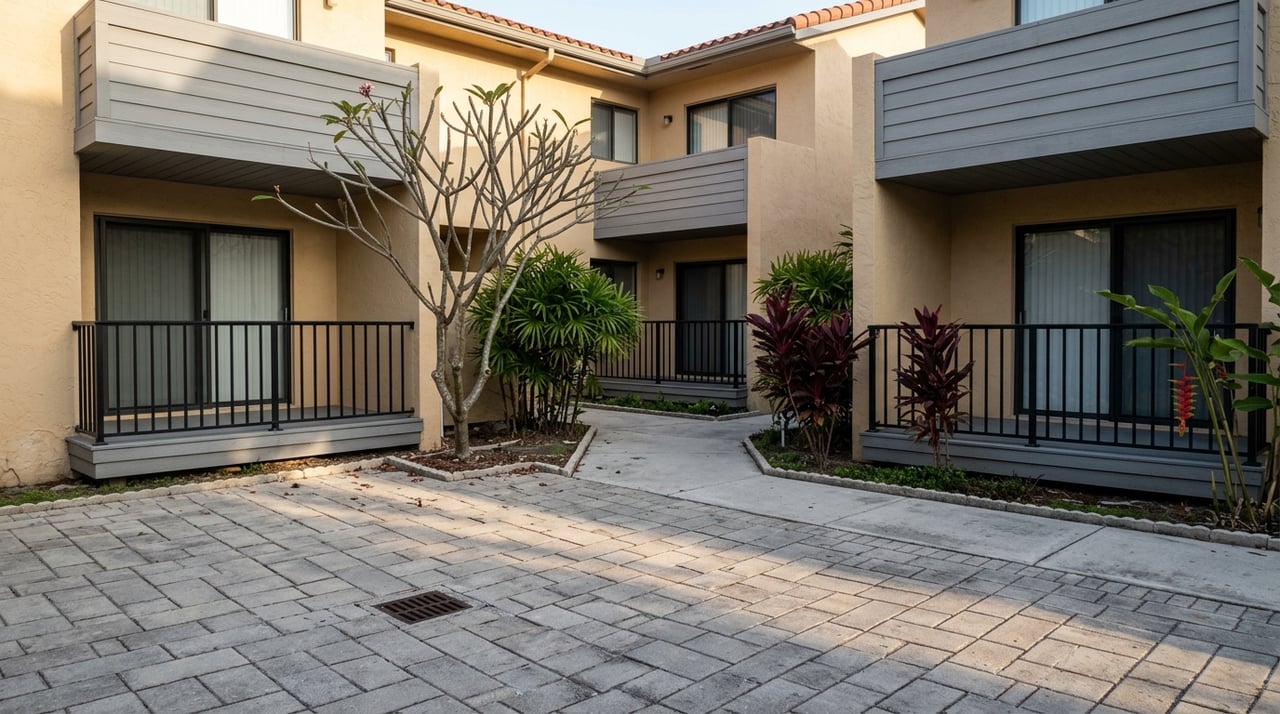
Two listings went up in Hawaii Kai the same week this summer. One was a three-bedroom townhome at Nanea Kai, priced $10,000 below its June 2026 appraised value of $935,000, pet friendly, a short walk from Hawaii Kai Towne Center. The other was a newly built five-bedroom estate in Na Pali Haweo, steel-framed, never lived in, still working through its 2026 permitting. Both listings say Hawaii Kai in the address. Neither tells you much about the other.
That gap matters more than usual right now. Hawaii Kai's single-family and condo markets are not just priced differently. As of July 2026 they are moving in opposite directions, and the reason has less to do with the water view than with what sits underneath the monthly payment: insurance, association reserves, and how much of the real cost a buyer actually sees before signing.
The Same Neighborhood, Two Different Markets
In July 2026, Hawaii Kai single-family homes sold at a median price of $1,572,500, down 5 percent from a year earlier. But the bid-up percentage, the share of homes selling above asking, climbed to 7.8 percent, up 11 percent year over year, while months of remaining inventory fell 24 percent to 4.7 months. Fewer homes are sitting unsold relative to the pace of sales, even with a softer median price.
Condos told a different story that same month. The median condo price in Hawaii Kai was $822,000, down 3 percent year over year, but the bid-up percentage collapsed 61 percent to just 6.8 percent. Median days on market rose 57 percent to 48 days, months of remaining inventory climbed 14 percent to 6.2 months, and active condo listings grew 17 percent to 75 units. Buyers have more condos to choose from and less reason to compete hard for any single one.
This isn't a one-month blip. In April 2026, Hawaii Kai condo sales rose 8 percent to 155 units, but the bid-up percentage had already dropped 57 percent to 9.0 percent, and median days on market had jumped 150 percent to 45 days. Condo competitiveness has been eroding for months.
| Hawaii Kai, July 2026 | Single-Family Homes | Condos |
|---|---|---|
| Median price | $1,572,500, down 5% year over year | $822,000, down 3% year over year |
| Bid-up percentage | 7.8%, up 11% year over year | 6.8%, down 61% year over year |
| Median days on market | 45 days, up 80% year over year | 48 days, up 57% year over year |
| Months of remaining inventory | 4.7 months, down 24% year over year | 6.2 months, up 14% year over year |
Even the home column doesn't tell one clean story. Days on market rose sharply while bid-up percentage and inventory both tightened. A single number pulled from a listing site rarely captures what's actually happening.
Why the Condo Side Is the One Losing Steam
The mechanism behind the split is carrying cost, not location. Statewide, 42 percent of Hawaii's owner-occupied households report paying a monthly HOA or AOAO fee, compared with 25 percent nationally, and Hawaii ranks second in the country for median monthly HOA fees at $470. Honolulu's median runs higher at $526. Active Oahu listings advertised in February 2026 carried a median AOAO fee of $882, nearly double the statewide figure, a sign of how quickly fees have climbed on older buildings as insurance premiums and reserve requirements get repriced.
Nanea Kai is a useful example. Built in 2003 with about 87 residences, it's newer than much of the condo stock scattered around East Honolulu, and a well-run AOAO there is doing what it should: funding reserves, carrying building insurance, and avoiding the kind of deferred maintenance that turns into a surprise special assessment. That work costs money every month, and it's a line item a buyer has to underwrite before comparing a condo's lower sticker price to a single-family home's higher one. Marina-front buildings like Esplanade and Colony at the Peninsula typically run monthly fees somewhere between $500 and $1,000, depending on the building and unit.
A $650,000 gap between a marina condo and a comparable single-family home starts to look smaller once a rising AOAO bill and building insurance are added to the monthly math, and that's before factoring in a mortgage rate that treats leasehold or fee-simple status differently.
Three Versions of Hawaii Kai, Three Different Price Logics
Marina front. This is the segment where the AOAO fee buys something specific: a dock, a view of the water, or both. Recent examples include a Nanea Kai townhome at $925,000 and a corner-end unit in the same building at $945,000, an Esplanade penthouse that moved between $918,000 and $925,000, a Gateway Peninsula corner unit at $1,395,000 for roughly 1,850 square feet, Koko Isle townhouses at $1,350,000 and $1,390,000, a four-bedroom Kuapa Isle waterfront townhome at $1,450,000, and a Hale Ka Lae flex unit at $890,000. Hawaii Kai remains the only community in Hawaii built around a private boating marina, governed by no-wake zones and a no-racing rule that keeps the water usable for paddlers as well as boat owners. That access is part of what the monthly fee funds, not just landscaping.
Ridge. Homes in Mariners Ridge, Kamehame Ridge, Portlock, and Na Pali Haweo trade the dock for elevation, privacy, and sweeping ocean or sunrise views. Recent Mariners Ridge inventory has listed around $2.3 million and $2.395 million, and a Kamehame Ridge home sold for $2.385 million earlier this year. Portlock's gated streets and Na Pali Haweo's newer custom construction sit at the top of this tier. These are fee-simple single-family lots, which removes the AOAO variable entirely but adds the full cost of a private pool, landscaping, or a boat slip elsewhere if a buyer still wants water access.
Valley. Kalama Valley and Hahaione Valley sit further inland, away from both the marina and the ridge views. Kalama Valley alone has roughly a thousand homes, and it's where a buyer typically finds more square footage and yard space per dollar without paying for either the marina premium or the ridge view. A recently renovated single-level Kalama Valley home with vaulted ceilings and skylights is a fair example of what that tier looks like when it's been updated.
How the Marina Premium Compares to Nearby Windward Neighborhoods
Comparing Hawaii Kai to Kaneohe and Kailua puts a number on what the marina and coastal proximity actually cost. Kaneohe's condo median in July 2026 was $660,000, up 2 percent year over year. Kailua's condo median was $800,000, down 1 percent. Hawaii Kai's condo median of $822,000 sits close to Kailua and roughly $160,000 above Kaneohe, which is a reasonable proxy for what marina access and East Oahu retail proximity add to a comparable Windward condo.
The single-family gap is larger. Kaneohe's home median in July 2026 was $1,280,000, down 1 percent year over year, versus Hawaii Kai's $1,572,500, a difference of nearly $300,000. Most of that gap reflects the ridge and valley homes that make up the bulk of Hawaii Kai's single-family inventory, not direct waterfront, since true marina-front houses are rare and priced well above the median.
For a buyer chasing affordability inside East or Windward Oahu, Kaneohe offers a lower entry point without the AOAO premium tied to marina infrastructure. For a buyer who specifically wants the dock, the marina view, or Hawaii Kai Towne Center and Koko Marina Center within a few minutes' drive, that premium is the actual product being purchased, and it should be measured against the ongoing fee structure rather than the purchase price alone.
Common Questions
Is Hawaii Kai a leasehold market? Generally no. Recent listings, including the Nanea Kai unit at 7018 Hawaii Kai Drive, have specifically flagged fee-simple ownership as a feature. Statewide, leasehold condos are concentrated in Waikiki, Downtown Honolulu, Makiki, and the University area, with smaller pockets in Pearl City, Kahala, and Windward Oahu. Hawaii Kai isn't typically named among those concentration areas, but confirming tenure on the title before writing an offer is still worth doing on any Oahu purchase.
Why did condo competition fall so much faster than home competition? The bid-up percentage measures how often buyers pay above asking. Rising AOAO and insurance costs on older buildings have made condo carrying costs less predictable, which slows buyer urgency even when the purchase price itself is falling. Single-family homes don't carry that same association-fee exposure, which is part of why their inventory has stayed tighter even as days on market rose.
Are most Hawaii Kai homes actually on the water? No. The marina-front tier is a small slice of the neighborhood. Most single-family inventory sits in ridge communities like Mariners Ridge and Kamehame Ridge or inland valleys like Kalama Valley and Hahaione Valley, none of which carry a boat dock or direct marina frontage.
If you're weighing a Hawaii Kai condo against a ridge or valley home, or trying to figure out how the marina premium fits your budget against a Windward alternative, that's exactly the kind of comparison worth running with someone who tracks these numbers month to month. Melvin Leon Guerrero works both sides of this market regularly and can walk through the AOAO documents, the comps, and the financing details specific to the building or block you're considering. Let's Connect.