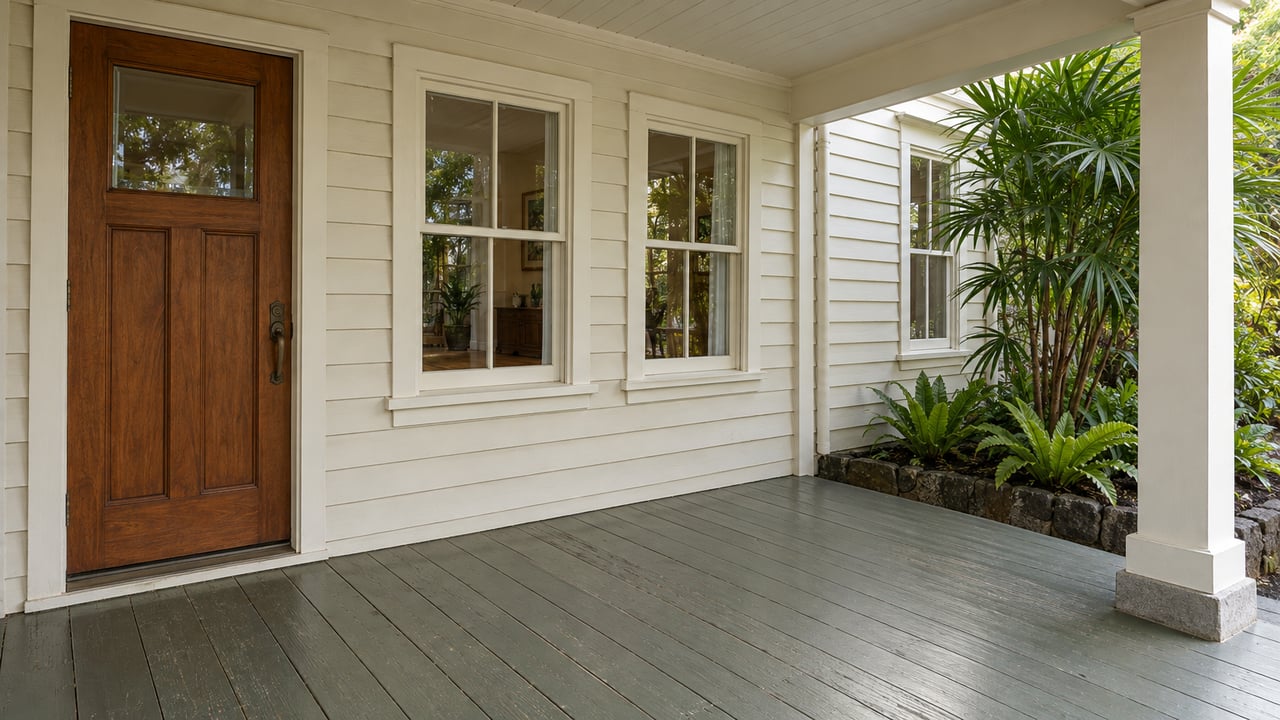
On East Mānoa Road there is a 1915 Craftsman bungalow designed by Oliver Traphagen, the architect of the Moana Surfrider. It has coffered ceilings, an Italian-tile fireplace and stained-glass roses on its built-in hutches. Honolulu Magazine describes it as an officially designated historic home. A few streets away, a buyer could find a house of about the same age, with the same eaves and the same lava-rock chimney, and no designation at all. The two look alike from the curb. If you want to add a primary suite to either one, they sit on different legal tracks.
Many buyers looking at Mānoa assume age is the variable that matters. In practice, age only gets a house flagged, while register status decides whether state historic review applies, and most of the actual wait comes from a city permit queue that every house shares.
The Flag Every Older Mānoa Parcel Carries
Honolulu's Department of Planning and Permitting lists State Historic Preservation review for any parcel with a structure 50 or more years old, and says those parcels carry an advisory. Much of Mānoa's housing went up between the 1910s and the midcentury era, so many parcels in the valley carry that flag. When a buyer pulls up a parcel and sees a historic preservation note on a 1950s house, it's easy to assume a long state review is coming.
State law draws the line much more tightly than the flag does. Under Section 6E-42.2 of the Hawaii Revised Statutes, as amended in 2026, a project on an existing privately owned single-family detached home or townhouse goes through state historic review only if the home is over 50 years old and at least one of these applies:
- The property is listed on the Hawaiʻi or National Register of Historic Places.
- The property has been nominated for either register.
- The property is located in a historic district.
- The project includes ground-disturbing work on a property with previously identified burials or cemeteries.
The first three conditions were already in the statute before this year. The 2026 amendment added the fourth. So for an unlisted, un-nominated house outside a historic district, with no identified burials on the property, age alone does not bring in this review, whatever the parcel advisory suggests.
What Act 076 Changed for Homes That Are Listed
For houses that do fall inside those four conditions, 2026 changed the timing. House Bill 1710 became Act 076 on June 3, 2026 and took effect July 1, 2026. Under the enacted text:
- The State Historic Preservation Division has 90 days to respond.
- That window drops to 35 calendar days when no historic properties would be adversely affected.
- Once a complete submittal is in, if the division doesn't respond within the applicable window, the act lets the party named for that review path assume concurrence and move to the next step. For a privately owned property reviewed under Section 6E-10, that party is the property owner. Under Section 6E-42, it is the lead agency.
For a buyer, this turns an open-ended wait into a defined one. A listed Mānoa home still carries an extra review layer, but that layer now has a deadline attached. The word "complete" matters, because the clock runs from a complete submittal. A set of plans that comes back with questions has not started the countdown the way the owner may expect.
Why Listing Clusters in Valleys Like Mānoa
If listing adds review, why would an owner choose it? The State Historic Preservation Division's Hawaiʻi Register page answers in one place. Private residential properties on the register are eligible for county property-tax benefits and may qualify for grants. Alterations to a listed home are subject to state review. The tax benefit and the review requirement come together, and an owner who accepts one accepts both.
That trade has played out across Honolulu's older neighborhoods. The statewide register holds 1,127 properties, about 400 of them houses or residences, and roughly 340 of those residences are on Oʻahu, according to Honolulu Magazine's July 2026 survey of historic homes. The same piece names Mānoa, Nuʻuanu and Diamond Head as neighborhoods where listed homes are concentrated.
Mānoa also has an organized preservation community. Linda LeGrande, a board member of the nonprofit Mālama Mānoa, lives in a state-designated historic home. She helped launch the group's first historic homes walking tour in 1996, which drew 66 people. About 450 attended in 2019, the last year it was held. In the same Honolulu Magazine piece, she said she hopes the valley's College Hills tract will someday be added to the National Register. That is a goal, not a designation. Still, the third condition in the statute is location in a historic district, so a buyer looking in College Hills should know the idea exists.
The valley's best-known landmarks show what is formally on the register. Mānoa Heritage Center, founded in 1996, cares for Kūaliʻi, the Cooke family's 1911 Tudor-style home. The center says Kūaliʻi and Kūkaʻōʻō Heiau are listed on the National Register. Hale Huelani, a 1929 Craftsman cottage in upper Mānoa, has owners who have deliberately kept its wood planks, canec walls and vintage hardware. The article praises the house's character without saying whether it is listed. That is the same uncertainty a buyer faces at a showing.
Even good-faith sources can blur this. Historic Hawaiʻi Foundation's online catalog has an entry for the 1926 Peterson Residence at 3034 Mānoa Road, with a state historic site number. The foundation itself warns that its catalog is not the official register list. A site number, a plaque story or a walking-tour stop does not confirm listing. Only the official register does.
The Queue Every House Shares
Register status decides whether a state review gets added. It does not touch the city permit line, which listed and unlisted houses wait in alike. Hawaiʻi Public Radio reported on September 24, 2026 that residential permits issued in 2026 averaged 218 days from application to issuance. The citywide backlog stood at 9,252 permits. The department told HPR that the backlog count includes applications in edits, applications waiting on applicant revisions, permits already in issuance, and dormant legacy cases, with more than 2,000 idle for over a year.
The city is changing how applications come in. DPP Director Dawn Takeuchi Apuna told the City Council that early results with the CivCheck and HNL Build tools showed review cycles down 58% and corrections down 67%, with an average of 40.5 review days saved. HPR also reported that CivCheck became mandatory for residential permit applicants on September 1. The tool screens plans for completeness before they enter government review. For an older house with decades of undocumented changes, plan quality is now one of the main ways to cut the wait.
Mānoa already appears in the city's permit coverage. In June 2026, Civil Beat reported on architect Milan Heger, who was designing a master-suite addition to a mid-century Mānoa residence and had not heard back three or four months after submitting the application. That delay was in the city queue, not a state historic review. Even an unflagged house can spend months there.
Compare that with how fast purchases happen. In August 2026, Oʻahu single-family homes had a median of 17 days on market, down from 22 in August 2025, according to the Honolulu Board of REALTORS. A buyer may have a couple of weeks to commit to a house whose renovation permit could take most of a year.
What to Settle Before Writing the Offer
- Confirm register status from the official source. Check the state and National Register records directly rather than relying on plaques, foundation catalogs or tour histories.
- Note the DPP parcel advisory and ask what it covers. DPP ties the advisory to parcels with 50+ year structures or iwi kupuna, and the statute's conditions for state review are a separate list.
- Ask whether the property is in a historic district. The statute names location in a historic district as one of the conditions, so whether a home sits in one is a question for the relevant agency or an attorney.
- Map the scope against permit exemptions. DPP says additions require building permits. Its list of common exemptions includes maintenance repairs under $10,000 per 12-month period using similar materials, plus painting, cabinets, flooring, and replacement windows or doors. A cosmetic refresh and a lānai enclosure are very different projects.
- Pull the permit history. Past additions that were never permitted on an older house can complicate a new application, so ask for records early.
Common Questions
Does a 1950s Mānoa house automatically go through state historic review? The 2026 text of Section 6E-42.2 lists age over 50 years as one requirement and adds four conditions, at least one of which must also apply. How it applies to a particular house is a question for the agency or an attorney.
If I buy a listed home, can I still renovate it? The Traphagen bungalow on East Mānoa Road shows that designated homes do get updated. Its owners enclosed the wraparound lānai to add a family room and a fourth bedroom. For a listed home, alterations go through state review, which now has the deadlines set by Act 076.
Does listing affect property taxes? SHPD says listed private residences are eligible for county property-tax benefits. Confirm the specific terms with the City and County of Honolulu.
This post is general information, not legal or tax advice. Before you rely on any of these rules, confirm how they apply to a specific property with an attorney, an architect or the relevant agency.
If you're weighing an older Mānoa house and want to know where its register status and permit history stand before you make an offer, Melvin Leon Guerrero can help you get those questions answered early. Let's Connect.